


Understanding Turbo Lag: The Engineering Challenge in Forced Induction
Turbochargers have revolutionized internal combustion engines by delivering impressive power gains from smaller displacement units. However, one characteristic phenomenon remains at the heart of turbocharger design and driver experience: turbo lag. This brief delay between throttle application and the delivery of peak boost pressure has shaped decades of automotive engineering, leading to innovative solutions that continue to evolve today.

What Exactly Is Turbo Lag?
Technical Definition: Turbo lag refers to the time delay between the driver’s demand for increased power (throttle opening) and the turbocharger’s delivery of maximum boost pressure to the engine’s intake manifold. This interval typically ranges from 0.5 to 3 seconds depending on turbo size, engine characteristics, and technology employed.
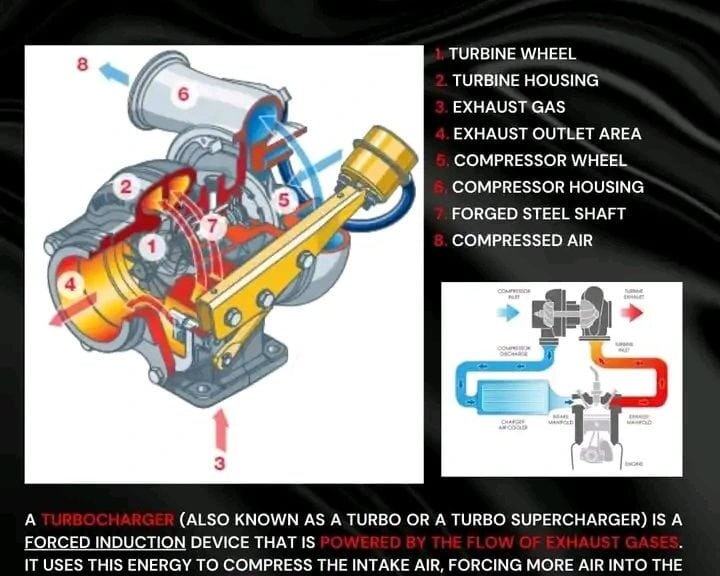
The phenomenon occurs because turbochargers are powered by exhaust gases. When the throttle opens, several sequential events must occur:
- Exhaust gas volume and velocity must increase as engine RPM rises
- The exhaust gas must overcome the inertia of the turbine wheel and shaft assembly
- The compressor wheel must accelerate to its operational speed (often 100,000+ RPM)
- The intake system must fill with compressed air to reach target boost pressure
💡 Key Insight: Turbo lag is fundamentally different from general engine responsiveness. It specifically describes the delay in achieving peak boost pressure, not merely the time for the engine to accelerate. A vehicle may feel responsive at low boost levels while still experiencing significant lag before reaching maximum power.
Primary Factors Contributing to Turbo Lag
| Factor | Mechanism of Influence | Engineering Trade-off |
|---|---|---|
| Turbocharger Size & Inertia | Larger turbo wheels have greater rotational mass, requiring more energy and time to accelerate | Large turbos provide high peak power but increase lag; small turbos reduce lag but limit peak flow |
| Exhaust System Design | Longer exhaust paths and restrictive manifolds delay exhaust gas arrival at the turbine | Optimized headers improve response but increase complexity and cost |
| Engine Displacement & RPM Range | Smaller engines produce less exhaust energy at low RPM, slowing turbo spool-up | Higher displacement provides better low-end response but reduces efficiency gains |
| Boost Pressure Targets | Higher target pressures require more turbine energy and longer spool times | Aggressive boost maps increase power but exaggerate lag characteristics |

Modern Engineering Solutions to Minimize Lag
Automotive engineers have developed increasingly sophisticated approaches to address turbo lag without sacrificing the efficiency and power benefits of forced induction.
Variable Geometry Turbochargers (VGT)
Adjustable turbine vanes optimize exhaust gas flow across different RPM ranges. At low RPM, vanes narrow to increase gas velocity and spool the turbo quickly. At high RPM, vanes open to maximize flow and prevent backpressure.
Common Applications: Modern diesel engines, Porsche 911 Turbo, Ford EcoBoost
Twin-Scroll Turbo Design
Separates exhaust pulses from different cylinders into two scrolls, preventing pulse interference and maintaining higher exhaust gas velocity to the turbine. This improves low-end response by up to 15-20% compared to single-scroll designs.
Key Benefit: Maintains exhaust pulse energy more efficiently throughout the RPM range
Electric Turbochargers & Hybrid Assist
Electric motors supplement or replace exhaust-driven spooling. An electric motor can instantly spin the compressor before exhaust gases build, effectively eliminating lag. Some systems recover energy from regenerative braking.
Cutting Edge: Audi SQ7 TDI, Mercedes-AMG One hypercar, Formula 1 MGU-H
Sequential & Twin-Turbo Systems
Uses a small, low-inertia turbo for quick response at low RPM and a larger turbo for high-RPM power. A sophisticated valve system routes exhaust gases appropriately. Provides the benefits of both small and large turbos.
Heritage Example: Toyota Supra (2JZ-GTE), Mazda RX-7 (13B-REW)
Supporting Technologies
Several complementary technologies work alongside turbocharger design to improve perceived responsiveness:
- Direct Fuel Injection: Allows higher compression ratios and more precise combustion timing, improving low-RPM torque
- Lightweight Turbine Materials: Ceramic or titanium turbine wheels reduce rotational inertia by 30-40%
- Advanced Engine Management: Predictive algorithms anticipate throttle input based on driving patterns
- Anti-Lag Systems (Motorsport): Retards ignition timing to create combustion in the exhaust manifold, maintaining turbo spool between shifts
Driver Experience vs. Engineering Reality
It’s important to distinguish between measurable turbo lag and subjective driving experience. Modern turbocharged vehicles often employ several strategies to minimize the perception of lag:
- Torque Fill Technologies: Electric motors in hybrid systems provide instant torque while the turbo spools
- Transmission Programming: Aggressive downshift logic keeps engines in optimal RPM ranges
- Throttle Mapping: Electronic throttle systems can create more linear response curves despite boost delay
- Momentum Conservation: Mild-hybrid systems use belt-starters to maintain engine RPM during gear shifts
Frequently Asked Questions
Is turbo lag always a sign of a fault?
Do smaller engines always have more turbo lag?
Can an electric-assisted turbo reduce turbo lag?
The Future of Forced Induction Response
As emissions regulations tighten and electrification advances, turbo lag continues to evolve from an engineering challenge to a managed characteristic. The integration of 48-volt electrical systems, more sophisticated hybrid architectures, and advanced materials science suggests that future forced induction systems may make lag virtually imperceptible while delivering unprecedented efficiency and power density.
The ongoing refinement of turbocharger response represents one of the most dynamic areas of automotive engineering—a continuous balancing act between instant response, peak power, thermal efficiency, and emissions compliance that continues to drive innovation in powertrain design.